

Table of Contents
- Why Down-Alternative Pillows Can Work Well in Hospitals
- What Should Hospitals Look for in Down-Alternative Pillows?
- How Hospitals Can Evaluate the Best Down Alternative Pillows
- Why Bulk Pillow Purchasing Makes Sense for Hospitals
- Durability and Long-Term Pillow Performance
- Pillow Sizing and Hospital Bed Compatibility
- Managing Pillows Across Different Hospital Departments
- Laundry and Maintenance Considerations
- How to Calculate Hospital Pillow Inventory
- Comparing Suppliers for Hospital Pillow Purchases
- Direct Textile Store: A Dedicated Source for Hospital Pillow Programs
- Creating a More Efficient Hospital Pillow Program
- Final Thoughts
- Learn More About Our Experience Supplying Wholesale Linens → About Direct Textile Store
- FAQ
- Related Posts
Choosing the right alternative pillows for a hospital requires more than finding a soft pillow at a competitive price. Healthcare facilities need patient bedding that supports comfort, hygiene, housekeeping efficiency, inventory control, and repeated use. A hospital may need hundreds or thousands of pillows across patient rooms, emergency departments, recovery areas, clinics, and temporary care spaces. That makes material, construction, size, laundering requirements, and bulk availability important purchasing considerations.
Best down alternative pillows can be a practical choice for hospitals because they can provide a familiar, comfortable feel while offering an alternative to traditional down-filled construction. For healthcare purchasing teams, the goal is to find a pillow that fits the facility's patient-care environment and can be incorporated into an organized bedding program.
The right supplier should also understand institutional purchasing. Hospitals need predictable case quantities, consistent product specifications, practical replacement inventory, and products that can work within established housekeeping and laundry procedures. Rather than treating pillows as occasional replacement items, healthcare facilities can benefit from establishing a standardized pillow program based on patient needs and operational requirements.
Why Down-Alternative Pillows Can Work Well in Hospitals
Hospital bedding has to serve two purposes at the same time: it should provide a comfortable experience for patients while remaining practical for healthcare staff to manage.
Pillows are used continuously throughout patient care areas. They may be placed in beds, examination rooms, recovery spaces, waiting areas, and other settings where patients need support.
Comfort Is an Important Part of Patient Care
A hospital stay can be physically and emotionally demanding. Something as simple as a comfortable pillow can contribute to a more accommodating patient environment.
Patients have different preferences regarding firmness, loft, and overall feel. While no single pillow can satisfy every patient, a standardized down-alternative option can provide a practical baseline for general hospital use.
Healthcare facilities may also choose to maintain different pillow types for specific patient requirements rather than expecting one product to serve every purpose.
Familiar Feel Without Traditional Down Filling
Down-alternative construction is designed to provide a soft, cushioned feel without using traditional down fill.
This can make the category appealing to facilities that want the comfort characteristics associated with a fluffy pillow while selecting a different filling construction.
The specific feel depends on the fill, shell, loft, and construction of the individual pillow. Buyers should therefore evaluate the complete product instead of assuming that every down-alternative pillows will perform identically.
Practical for Standardized Bedding Programs
Hospitals benefit from standardization. When the same general pillow specification is used across multiple departments, staff members can become familiar with the product and purchasing teams can maintain a more predictable inventory.
Standardization can also make replacement easier. Instead of keeping track of numerous pillow models, a facility can establish approved products for general patient use and specialized applications.
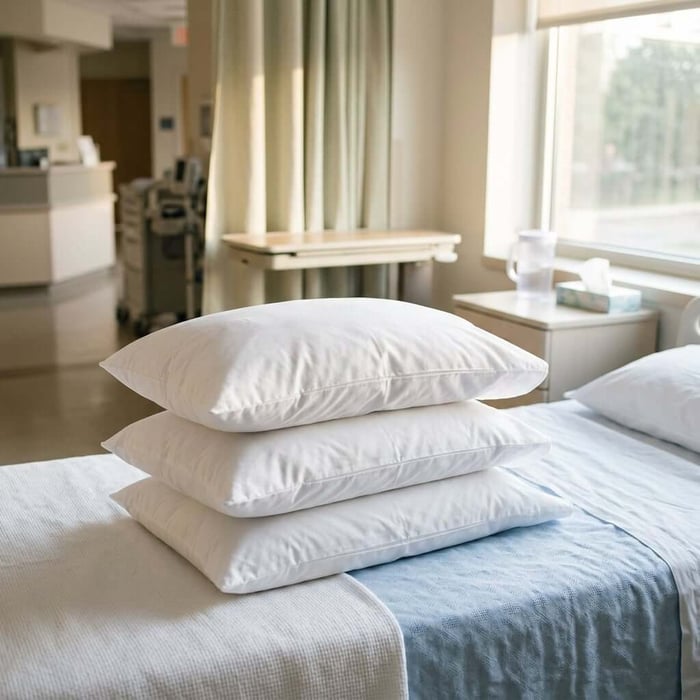
What Should Hospitals Look for in Down-Alternative Pillows?
Healthcare buyers should evaluate pillows from both the patient and operational perspective.
A pillow that feels comfortable but is difficult to maintain may not be suitable for a high-volume hospital. Likewise, a highly durable pillow that does not provide an appropriate level of comfort may not meet patient-care expectations.
Evaluate the Fill Construction
The filling affects the pillow's loft, softness, resilience, and overall feel.
Down-alternative fills can vary considerably. Some are designed to mimic the loft of down, while others provide a firmer or more structured feel.
Hospitals should consider how the pillow will be used. A general patient pillow may require a different balance of loft and firmness than a pillow intended for a guest area or administrative space.
Examine the Pillow Shell
The outer shell is another important consideration. A pillow's shell contains the filling while providing the surface that interacts with the pillowcase.
Look for consistent stitching and a construction that is appropriate for the intended institutional environment.
The shell should also work well with the facility's pillowcase inventory. Proper sizing reduces unnecessary movement inside the case and helps staff maintain a neat bed presentation.
Consider Loft and Firmness
Not every patient prefers the same pillow.
Some patients may prefer a fuller, softer pillow, while others may require more support. A hospital can address this by selecting a versatile general-use pillow and maintaining additional options where patient needs justify them.
Purchasing teams should consider whether the selected pillow provides enough support without becoming excessively firm or bulky.
How Hospitals Can Evaluate the Best Down Alternative Pillows
Searching for the best down alternative pillows can produce many different options, but hospitals should define "best" according to their actual operating requirements.
Match the Pillow to the Patient Population
A hospital serving adults may have different general pillow requirements from a pediatric facility, rehabilitation center, or long-term care environment.
Patient age, mobility, typical length of stay, and clinical requirements can all affect the appropriate pillow choice.
Purchasing teams should work with nursing and clinical staff to understand the needs of the patients who will use the pillows most frequently.
Consider the Bedding System as a Whole
A pillow does not operate independently. It is part of a larger bedding system that may include mattresses, mattress pads, sheets, blankets, pillowcases, and protective covers.
The pillow should fit naturally within that system.
For example, an oversized pillow may not fit existing pillowcases properly, while a very low-profile pillow may not provide the desired presentation or support.
Review Samples Before a Large Purchase
When possible, healthcare buyers should evaluate samples before ordering a large case quantity.
Staff can inspect the pillow's dimensions, loft, feel, construction, and overall appearance. A sample can also be compared with the facility's existing pillowcases and bedding.
This small evaluation step can prevent larger procurement problems later.
Why Bulk Pillow Purchasing Makes Sense for Hospitals
Hospitals have continuous bedding requirements. Individual pillow purchases may be appropriate for occasional replacement, but larger facilities generally benefit from a planned bulk purchasing strategy.
Maintain Adequate Inventory
A hospital needs pillows available for occupied rooms, turnover, cleaning, replacement, and unexpected demand.
Keeping only the exact number required for currently occupied beds creates unnecessary risk. A damaged or unavailable pillow can leave staff searching for a replacement when time is already limited.
A reserve inventory provides additional flexibility.
Case Packs Can Simplify Replenishment
Case-pack purchasing gives healthcare buyers a predictable quantity for inventory planning.
Instead of ordering one pillow at a time, purchasing teams can establish reorder points based on average usage and replacement rates.
The ideal case quantity depends on the facility's storage capacity and consumption patterns.
Standardization Reduces Procurement Complexity
When a hospital uses a consistent pillow specification, future orders are easier to manage.
Purchasing teams know which product to reorder, housekeeping staff know how the item should be handled, and clinical staff become familiar with its characteristics.
Standardization also reduces the risk of unintentionally mixing multiple pillow sizes or constructions within the same patient-care area.
Durability and Long-Term Pillow Performance
Hospital pillows can experience significant handling during their service life. They are moved between rooms, placed into pillowcases, removed for cleaning, stored, and redistributed.
This makes construction an important part of the purchasing decision.
Repeated Handling Can Affect Pillow Shape
Pillows can gradually lose loft or develop uneven filling as they are used and handled.
Healthcare buyers should consider how well the pillow is expected to maintain its shape during normal institutional use.
A pillow that quickly becomes flat or misshapen may need to be replaced more frequently, increasing both purchasing and labor costs.
Seams and Edges Matter
The edges and seams help contain the filling and maintain the overall shape of the pillow.
Inspecting these areas can provide insight into construction quality. Buyers should look for consistent stitching and appropriate finishing throughout the product.
Replacement Planning Should Be Built In
Even durable hospital pillows eventually reach the end of their useful life.
Facilities should establish a process for identifying pillows that are excessively worn, misshapen, damaged, or otherwise unsuitable for continued use.
Keeping replacement stock available allows staff to remove worn products without creating shortages.
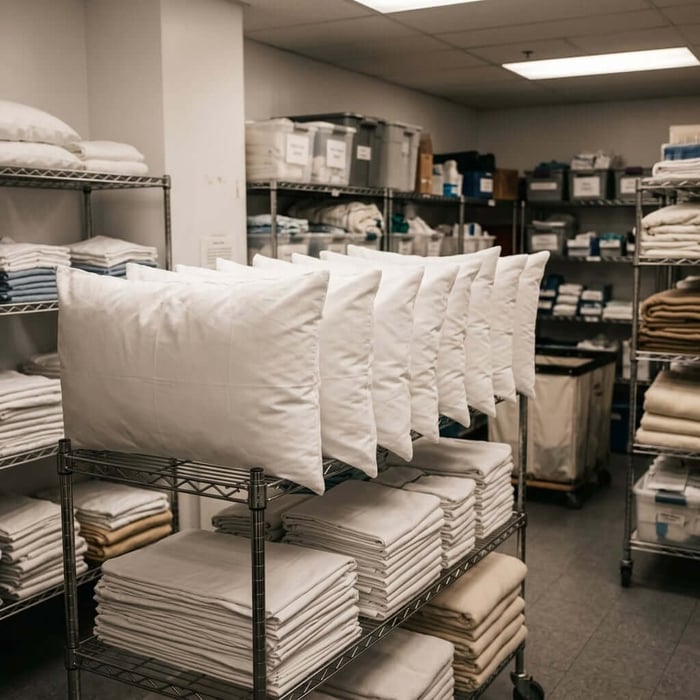
Pillow Sizing and Hospital Bed Compatibility
Sizing is often overlooked when purchasing pillows in bulk, but it can have a significant impact on daily operations.
Match Pillow Dimensions to Existing Cases
The simplest approach is to review the pillowcases currently used by the facility.
The selected pillow should fit appropriately within those cases without excessive bunching or empty space.
If the hospital is replacing both pillows and pillowcases, purchasing teams should make sure the two products are coordinated before ordering.
Standardize Where Practical
A hospital may use a standard pillow size for general patient rooms while maintaining other sizes for specific departments.
This approach provides some flexibility without creating an unnecessarily complicated inventory.
Consider Storage Requirements
Pillows are relatively bulky compared with many other healthcare textiles. Large quantities can quickly consume storage space.
Purchasing teams should therefore consider both the case quantity and the available linen-room capacity.
An efficient storage plan can make it easier for staff to retrieve clean pillows during room turnover.
Managing Pillows Across Different Hospital Departments
Not every hospital department has identical bedding requirements.
Patient Rooms
General patient rooms typically require comfortable, versatile pillows that can be easily incorporated into standard bed setups.
Consistency is particularly valuable in these areas because staff may need to prepare numerous beds throughout the day.
Emergency Departments
Emergency departments can experience unpredictable patient volumes. Maintaining reserve pillows can help staff respond quickly during busy periods.
Because patient turnover may be high, purchasing teams should pay close attention to inventory rotation and replacement rates.
Recovery Areas
Patients recovering from procedures may spend extended periods in beds or reclining positions. Pillow comfort and support can therefore become particularly important.
Healthcare teams may also need flexibility in positioning pillows based on individual patient requirements.
Guest and Family Areas
Hospitals may use different pillows for waiting rooms, family accommodations, or guest spaces.
These areas do not necessarily require the same specifications as patient-care rooms, so maintaining separate standards can sometimes be appropriate.
Laundry and Maintenance Considerations
Hospitals should evaluate pillows in the context of their overall textile-management system.
Understand the Facility's Cleaning Process
Before ordering, buyers should review the product's care requirements and compare them with existing procedures.
A pillow that requires handling outside the facility's normal workflow can introduce additional labor or processing requirements.
Use Appropriate Pillow Protection
Pillowcases provide the first layer of protection for pillows during patient use. In some healthcare environments, additional protective covers may also be used according to facility procedures.
A well-organized protection strategy can help keep pillows cleaner and extend their useful life.
Inspect During Routine Linen Processing
Laundry and housekeeping staff can identify problems during normal handling.
Pillows showing significant loss of shape, damaged seams, contamination that cannot be adequately addressed, or other concerns should be removed according to the facility's established procedures.
How to Calculate Hospital Pillow Inventory
There is no single inventory number that works for every hospital. The correct quantity depends on bed count, patient turnover, cleaning procedures, storage capacity, and replacement patterns.
Start With the Number of Beds
Begin by identifying how many patient beds require pillows.
If different departments use different pillow specifications, calculate each category separately.
Add Turnover and Cleaning Rotation
Some pillows may be unavailable while they are being processed. Facilities should consider how long the cleaning or laundering cycle takes and maintain enough inventory to support normal operations.
Maintain a Replacement Reserve
A reserve helps absorb unexpected demand and normal product loss.
Historical replacement data can provide a useful basis for deciding how large that reserve should be.
Review Inventory Regularly
Inventory requirements can change as patient volumes fluctuate or departments expand.
Periodic reviews can help purchasing teams avoid both shortages and excessive overstocking.

Comparing Suppliers for Hospital Pillow Purchases
The supplier should be evaluated based on more than product availability.
Look for Consistent Product Specifications
A supplier should provide clear information about pillow dimensions, construction, fill, and intended use.
This makes it easier for healthcare buyers to compare products accurately.
Consider Bulk Availability
Hospitals generally need a supplier capable of supporting institutional quantities.
Case-pack availability can simplify procurement and help facilities establish predictable reorder cycles.
Think About Long-Term Reordering
A pillow program may continue for years. Buyers should consider whether the supplier can support future replenishment of the selected product.
Consistent access to an approved product can simplify inventory management and reduce the need to repeatedly evaluate new alternatives.
Direct Textile Store: A Dedicated Source for Hospital Pillow Programs
For hospitals looking for a dedicated commercial textile supplier, Direct Textile Store provides hotel and hospital-style bedding options designed for institutional purchasing. Buyers can evaluate pillow selections based on patient needs, bed configurations, inventory requirements, and existing housekeeping procedures.
Order from Direct Textile Store hotel and hospital styles down-alternative pillows with case-pack pricing for hospitality and healthcare settings. Browse styles and case packs to outfit your operation.
Hotel and hospital-style pillow options for healthcare and hospitality environments
Down-alternative construction for facilities seeking an alternative to traditional down filling
Bulk case-pack purchasing to support hospital inventory requirements
Options for standardized bedding programs across patient rooms and other facility areas
Commercial-oriented textile selection for institutional purchasing teams
Practical replenishment options for maintaining reserve and replacement inventory
A dedicated supplier can make it easier for hospitals to establish a consistent pillow specification and maintain it over time. Rather than replacing pillows individually as they become unavailable, purchasing teams can plan inventory around bed counts, usage patterns, and expected replacement cycles.
Creating a More Efficient Hospital Pillow Program
A good pillow selection becomes more valuable when it is supported by an organized management process.
Establish an Approved Pillow Standard
The hospital can document the approved pillow dimensions, fill type, firmness, and other relevant characteristics.
This gives purchasing and housekeeping teams a shared reference point.
Separate General and Specialized Requirements
A general patient pillow may not be appropriate for every clinical situation. Where specialized patient needs exist, those requirements should be addressed separately rather than changing the standard pillow for every department.
This approach can help maintain simplicity while still allowing clinical flexibility.
Monitor Replacement Rates
Tracking how often pillows are removed from service can reveal whether the selected product and inventory level are appropriate.
If replacement rates are significantly higher than expected, the hospital can investigate potential causes and adjust future purchasing decisions.
Coordinate With Nursing and Housekeeping
Nursing staff can provide insight into patient comfort and usability, while housekeeping teams can explain how the pillow performs during daily handling and cleaning.
Purchasing decisions are stronger when these operational perspectives are considered alongside cost and availability.
Final Thoughts
The best place to buy alternative pillows for a hospital is a supplier that can support the facility's complete bedding program rather than simply provide individual products. Hospitals need pillows that balance patient comfort with practical handling, consistent sizing, durability, storage, and predictable replenishment.
Down-alternative pillows can be a useful option for healthcare facilities seeking a soft, familiar feel without traditional down filling. However, the best selection depends on the hospital's patient population, bed configurations, pillowcase inventory, cleaning procedures, and operational requirements.
When evaluating the best down alternative pillows, buyers should look beyond the initial feel of the product. Fill construction, shell quality, loft, firmness, dimensions, stitching, and expected service life all contribute to the overall value of a hospital pillow.
Bulk purchasing can also make a meaningful difference. Maintaining sufficient inventory for patient beds, cleaning rotation, replacements, and unexpected demand helps housekeeping and nursing teams avoid unnecessary shortages. Case-pack purchasing can make replenishment more predictable while reducing the administrative work associated with frequent small orders.
Ultimately, a hospital pillow program should be designed around consistency and practical patient care. Establishing clear specifications, maintaining reserve inventory, monitoring replacement patterns, and coordinating with clinical and housekeeping teams can help healthcare facilities manage pillows more efficiently.
For hospitals that want to balance patient comfort with institutional practicality, a standardized down-alternative pillow program can be a sensible part of a broader healthcare bedding strategy.

Learn More About Our Experience Supplying Wholesale Linens → About Direct Textile Store
Direct Textile Store is a leading U.S. wholesale linen and textile supplier trusted by over 131,000 hotels, hospitals, healthcare facilities, restaurants, spas, salons, resorts, gyms, emergency shelter and response, funeral homes, VRBO & Airbnb hosts, car washes, and commercial buyers nationwide. Shop in bulk with everyday low wholesale pricing and automatic 20% case-pack discounts — no coupons or minimums required. Choose from one of the largest in-stock selections available: over 135,000 towels, pool towels, sheets, blankets, comforters, tablecloths, pillows, bed toppers, aprons, hospital gowns, patient gowns, isolation gowns, scrubs, shower curtains, chef apparel, smocks, lab coats, uniforms, and commercial laundry equipment including wire, vinyl, and poly laundry carts, trucks, and privacy screens — all ready to ship today. Free shipping on orders over $5,999.
FAQ
What type of pillows are suitable for hospitals that need hotel-style comfort?
Hospitals often look for alternative pillows that combine patient comfort with the durability required for frequent clinical use. Down-alternative construction can provide a soft, familiar feel while offering practical maintenance characteristics for facilities that need pillows to be cleaned and reused regularly.
Why are down-alternative pillows used in healthcare environments?
Down-alternative fills can provide a consistent balance of softness and support without using natural down. The best down alternative pillows may also be easier to maintain and suitable for facilities that require regular laundering and standardized bedding across patient rooms.
How can hospitals choose pillows for different patient needs?
Hospitals should consider pillow size, firmness, fill type, washability, durability, and intended use when selecting bedding. Standardizing several suitable options can help staff accommodate different patient preferences while keeping procurement and inventory management straightforward.
What makes a pillow practical for frequent hospital laundering?
Pillows used in healthcare environments should be constructed to tolerate the facility's established laundering procedures while retaining their shape and comfort. Buyers should review care requirements, fabric durability, fill performance, and drying considerations before making a bulk purchase.
Can hospital-style pillows also provide the comfort associated with hotels?
Yes, certain alternative pillows can combine institutional durability with a softer hospitality-oriented feel. This can be useful for hospitals that want patient rooms to feel more comfortable and welcoming without sacrificing practical maintenance requirements.
How does buying pillows in larger quantities benefit hospital operations?
Bulk procurement helps hospitals maintain consistent bedding standards across departments while keeping replacement inventory available. It can also simplify purchasing and reduce the need to source different pillow types from multiple suppliers.
Where can hospitals source hotel and hospital-style alternative pillows?
Healthcare facilities can compare institutional textile suppliers that serve both hospitality and medical environments. Direct Textile Store is one option for sourcing alternative pillows and best down alternative pillows designed to combine comfort, durability, and the practical needs of high-use healthcare settings.