
Table of Contents
- Why Hospitals Rely on Vinyl for Bathing Areas
- Understanding Gauge, Weight, and Material Quality
- Grommet and Buttonhole Headers
- Curtains, Liners, and How They Work Together
- Hooks, Rings, and Rod Compatibility
- Sizing, Coverage, and Privacy
- Mildew Resistance, Cleaning, and Infection Control
- Matching Curtains to Hospital Areas
- How Many Curtains a Hospital Needs
- Why Wholesale Case Packs Make Sense
- Evaluating and Testing Samples
- Installation, Replacement, and Staff Workflow
- Procurement Planning and Common Mistakes
- Cost, Value, and Total Ownership
- Making the Purchase: A Practical Buying Checklist
- Direct Textile Store: A Dedicated Source for Hospital Shower Curtains
- Final Thoughts on Buying Vinyl Shower Curtains for a Hospital
- Learn More About Our Experience Supplying Wholesale Linens → About Direct Textile Store
- FAQ
- Related Topics
A hospital bathroom is a place where privacy, hygiene, and safety all meet at a single piece of fabric hanging from a rod. Patients depend on the curtain for dignity during bathing, staff depend on it to keep water contained, and infection prevention teams depend on it being easy to clean and easy to replace. Because a hospital may have hundreds of bathrooms and shower rooms, the choice of curtain is a volume decision as much as a product decision. Vinyl shower curtains are widely used in healthcare because the material resists water, wipes clean, and can be replaced quickly when needed. This guide explains how to evaluate gauge, headers, and liners, how to match curtains to hospital areas and rods, how to calculate quantities, and how to buy in case packs so that every bathroom is ready and every replacement matches.
Why Hospitals Rely on Vinyl for Bathing Areas
Water Resistance That Protects Floors and Staff
Vinyl is a non-porous material, which means water beads and runs off instead of soaking in. In a hospital, that matters for more than tidiness. Water that escapes a shower area creates slip hazards for patients and staff, and a curtain that absorbs moisture becomes heavy and slow to dry. A well-made vinyl curtain keeps water where it belongs and dries quickly between uses. That reliability is one reason vinyl shower curtains are so common across inpatient units, rehabilitation floors, and long-term care wings.
Surfaces That Can Be Wiped and Replaced Quickly
Infection prevention routines depend on surfaces that can be cleaned the same way every time. Vinyl wipes clean with common cleaning products and does not hold moisture the way fabric does. When a curtain is soiled, torn, or discolored, it can be replaced in minutes. That simplicity makes it easier to keep standards consistent across shifts and across units. A vinyl shower curtain liner can be added behind a decorative curtain when facilities prefer a softer look in patient rooms but still want a waterproof barrier.
Affordability at Facility Scale
A hospital may have hundreds of bathrooms, and curtains are replaced regularly. The cost of each curtain matters, but so does how long it lasts and how quickly staff can replace it. Vinyl offers a practical balance of price and performance, particularly when bought in volume. Wholesale case packs bring the per-curtain cost down further and keep replacements consistent. For many facilities, a reliable supply of vinyl shower curtains is one of the simplest ways to keep bathrooms in good condition without straining the supplies budget.
Understanding Gauge, Weight, and Material Quality
What Gauge Means for Durability
Gauge describes the thickness of the vinyl film. Thicker material resists tearing, holds its shape, and hangs more cleanly, while thin material tends to crease, tear at the header, and billow into the shower area. In a hospital, curtains are opened and closed many times a day by patients and staff, so durability is a practical requirement rather than a luxury. A genuine heavy duty shower curtain liner has the body to withstand that handling and keep its appearance.
Feel, Flexibility, and Hang
Beyond thickness, the quality of the vinyl affects how it feels and drapes. High-quality material stays flexible instead of becoming stiff or brittle over time, which makes it easier to open and close. It also hangs straight without clinging to the person bathing. When you handle samples, notice whether the curtain feels substantial yet supple. A well-constructed heavy shower curtain liner provides that balance and avoids the cheap, crinkly feel that signals early failure.
Odor, Surface, and Finish
New vinyl can have a noticeable smell, and some products retain it longer than others. Hospitals are sensitive environments, so it is worth checking samples for strong odors and for a smooth, even surface. A tacky or uneven finish can trap soil and make cleaning harder. Request samples and let them air out before judging. A clean, neutral, well-finished surface helps plastic shower curtain liner products perform well in clinical settings.
Grommet and Buttonhole Headers
Why the Header Matters Most
The header is the top edge where the curtain attaches to the rod, and it is where nearly every failure starts. Every time a curtain is pulled, the force concentrates on the openings that hold the hooks or rings. Weak headers tear, and a torn header can make a curtain unusable even when the rest is in good shape. Reinforced headers spread the load and extend life dramatically. For vinyl shower curtains in a busy hospital, header construction is one of the most important details to inspect.
Grommets: Metal-Reinforced Openings
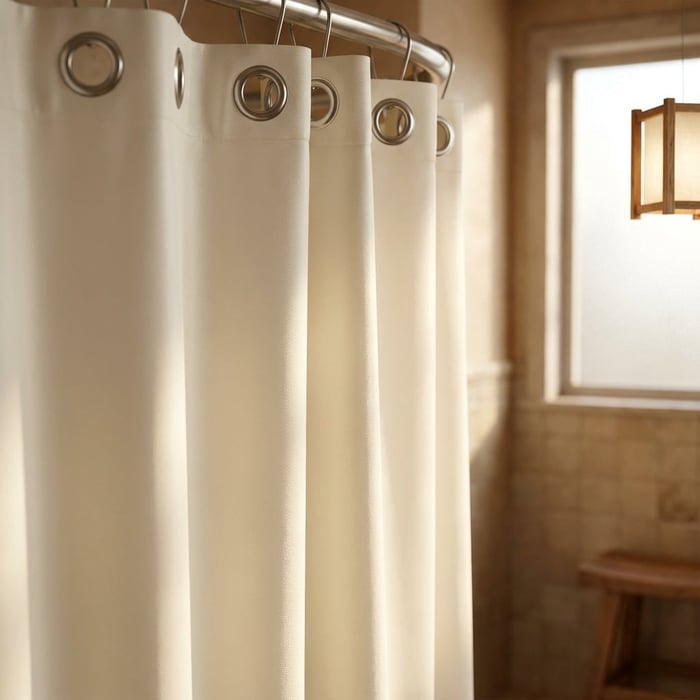
Grommet headers use metal or plastic rings set into the top of the curtain to reinforce each opening. They resist tearing, slide smoothly on a rod, and make installation easy. Grommets are particularly useful where curtains are handled heavily. Check that the rings are securely set and spaced evenly, and that they match the size of your hooks or rods. A well-made grommet header turns a heavy duty shower liner into a product that holds up through thousands of cycles.
Buttonhole Headers: A Simple, Classic Option
Buttonhole headers use reinforced slits in the vinyl rather than separate rings. They are simple and work with standard hooks, and they can be a good choice where ease of replacement and low cost matter. Reinforcement quality varies, so inspect the stitching or heat-sealing around each slit. Choose the header style that suits your hardware and your maintenance routine, and standardize across the facility so that every bathroom works the same way.
Curtains, Liners, and How They Work Together
Using a Curtain Alone
In many hospital bathrooms, a single vinyl curtain provides both privacy and water control. This is the simplest approach, with one product to buy, hang, and replace. It works well when the curtain is heavy enough to hang straight and large enough to contain splash. Standardizing on one curtain type reduces inventory complexity and makes training easy. For facilities that value simplicity, a good vinyl shower curtain liner can serve as the main curtain.
Pairing a Liner With a Decorative Curtain
Some hospitals prefer a fabric or decorative curtain on the room side for a softer, less clinical look, with a waterproof liner behind it. This approach separates appearance from function. The liner takes the moisture, while the decorative curtain stays drier and can be replaced less often. The trade-off is two products to manage per bathroom. A durable plastic shower curtain liner works well in this role.
Choosing a System Across the Facility
Whichever approach you choose, consistency matters. Mixed systems create confusion for housekeeping and complicate ordering. Decide which units use a single curtain and which use a pair, document the decision, and order accordingly. Facility-wide consistency also makes it easier to find replacements quickly and to train new staff on the standard setup.
Hooks, Rings, and Rod Compatibility
Matching the Header to the Hardware
Curtains only work if they match the rods and hooks already installed. Measure the rod diameter and the spacing of existing hooks, and confirm that header openings are the right size. A curtain that does not fit the hardware slows installation and may require new hooks or rods. Check this before ordering in volume, because mismatches are expensive to correct. A heavy shower curtain liner with standard header spacing is usually the easiest to install across mixed hardware.
Hookless Versus Hooked Systems
Some facilities prefer hookless curtains with built-in header slots that slide onto the rod, because they eliminate loose hooks that can go missing or become hazards. Others use hooks for flexibility. Each approach has advantages. Decide based on safety policy, maintenance preferences, and existing hardware. Standardizing reduces replacement complexity and avoids a drawer full of mismatched hooks.
Rod Strength and Safety
Hospitals often use breakaway or tension-release rods in certain units to reduce safety risks. If your facility has such requirements, make sure curtains work with those rods and that header openings do not stress them. Coordinate with facilities and safety teams before ordering. A curtain that works with the rod and releases appropriately supports both function and safety.
Sizing, Coverage, and Privacy
Standard Sizes and Real Measurements
Standard curtains are commonly sized for typical showers and tubs, but hospitals often have a mix of fixture types. Measure installed stalls, tubs, and roll-in showers rather than relying on plans. Confirm the dimensions of the curtain, including drop, so it covers the opening fully and stops near the floor or the tub edge. A curtain that is too short exposes patients, while one that is too long may drag and collect soil. Accurate sizing keeps vinyl shower curtains both private and practical.
Accessible and Roll-In Showers
Accessible showers may need wider or longer curtains, and operation matters for patients with limited dexterity. Make sure the curtain can be moved easily by staff or by patients using mobility aids, and that it does not interfere with equipment. Test samples in these configurations before ordering. Careful attention to accessible showers protects both dignity and safety.
Opacity and Dignity
Patients deserve privacy while bathing. Choose curtains with enough opacity to provide it, whether solid, frosted, or patterned. Very sheer curtains may not offer enough coverage in a clinical setting. Test samples under typical lighting to confirm privacy. Consistent opacity across the facility sets a clear standard for patient dignity.
Mildew Resistance, Cleaning, and Infection Control
Mildew-Inhibiting Treatments
Hospital bathrooms are humid, and curtains can develop mildew if moisture lingers. Some vinyl products include treatments designed to inhibit mildew growth between cleanings. Ask what treatment is used and request documentation. These treatments help keep curtains looking cleaner, but they do not replace regular cleaning. Choosing treated vinyl shower curtain liner products can reduce how often curtains look stained or smell musty.
Compatibility With Disinfectants
Environmental services teams use specific cleaning and disinfecting products. Confirm that the curtain material tolerates them without clouding, stiffening, or breaking down. Test samples with the products your teams use, and record the results. A curtain that degrades under your routine will cost more in replacements and may create risks.
Cleaning and Replacement Routines
Decide when curtains are wiped, laundered if applicable, or replaced, and document the process. Some hospitals replace curtains at each discharge, while others clean and reuse them until wear or soiling appears. The policy affects how many curtains you need. Make sure staff know where replacements are stored and how to report damage.
Matching Curtains to Hospital Areas
Inpatient Rooms and Private Bathrooms
Private bathrooms in patient rooms are used steadily and cleaned between admissions. A durable, easy-to-clean curtain keeps these rooms consistent. Many facilities prefer a straightforward, opaque curtain that is quick to replace. Standardizing on a single specification for these rooms keeps ordering simple and minimizes mistakes. Vinyl shower curtains in these areas should be sized to the fixture and matched to existing hardware.
Shared Shower Rooms and Therapy Areas
Rehabilitation units, behavioral health units, and shared bathing rooms see heavy use. Choose a heavy duty shower curtain liner with reinforced headers for these areas, and plan for more frequent replacement. Consider safety requirements for rods and hardware, particularly in units with special precautions. Durable products reduce disruption and maintenance calls.
Staff Facilities and Support Areas
Staff locker rooms and support-area showers benefit from the same easy-clean construction used in patient areas. Using the same specification simplifies inventory and training. Include these areas when calculating needs, since they are easy to overlook until a curtain fails.
How Many Curtains a Hospital Needs
Count Every Bathing Position
Count bathrooms, shower stalls, tubs, and roll-in showers across the facility, recording the type and size of each. Include staff areas and any spare or overflow locations. This count is the foundation for ordering and should be verified by walking the building. Accurate counts prevent shortages and over-ordering of vinyl shower curtains.
Plan for Replacement and Reserve
How often curtains are replaced determines how many you need on hand. A facility that replaces at every discharge needs a much deeper reserve than one that replaces quarterly. Add a reserve of ten to twenty percent for damage and surges. Track reserve usage so the percentage reflects reality. A reserve of heavy shower curtain liner stock allows immediate swaps without emergency purchasing.
A Worked Example
A hospital with 200 patient bathrooms, 20 shared shower rooms with 3 stalls each, and 15 staff showers has 275 bathing positions. If curtains are replaced twice per year, that is 550 curtains annually. Adding a fifteen percent reserve brings the annual need to about 633 heavy duty shower liner units, plus an initial stock for first-time outfitting. Writing the numbers down turns a vague need into a clear order.
Why Wholesale Case Packs Make Sense
Lower Cost Per Curtain
Case packs reduce packaging and handling costs, and that efficiency shows up in the price per curtain. For hospitals that need hundreds of curtains each year, ordering in cases is more economical than buying in small quantities. Direct Textile Store offers case-pack pricing on vinyl shower curtains, giving facilities a clear way to plan and budget.
Consistent Production Lots
Curtains in the same case typically come from the same production lot, so gauge, color, and header construction are consistent. That consistency matters when replacements must match existing curtains and when staff expect the same performance everywhere. Buying plastic shower curtain liner products from consistent lots keeps bathrooms uniform.
Simpler Ordering and Budgeting
Standardized quantities make counting, storing, and budgeting easier. Instead of managing many small orders, a hospital can plan a few larger purchases aligned with its fiscal calendar. Predictable pricing helps supply chain and finance teams forecast costs. Fewer, larger orders also reduce receiving and handling work.
Evaluating and Testing Samples
Inspecting Construction
Request samples and examine the vinyl, headers, and hems closely. Check that grommets or buttonholes are reinforced and that the edges are cleanly finished. Pull gently on the header to test strength. Compare samples side by side so differences in thickness and finish are easy to see. Take notes and photos for your records of vinyl shower curtains.
Wipe, Flex, and Cleaning Tests
Wipe samples with the cleaning products your teams use and observe the results. Flex them repeatedly and note any cracking, clouding, or stiffening. Hang samples in a humid environment for several days to see how they respond. These tests reveal how a vinyl shower curtain liner will behave under real conditions.
Gathering Staff Feedback
Ask environmental services, nursing, and facilities staff to try the samples. They can assess how easily curtains hang, open, and clean, and whether they work with existing hardware. Their feedback helps you choose a product that people will actually like using. Document the input and share the decision with the team.
Installation, Replacement, and Staff Workflow
Making Replacement Fast
When curtains are easy to install, replacement takes minutes, which keeps rooms available. Standard headers and compatible hardware are key. Keep replacement curtains, hooks, and any tools in a known location on each unit or in a central supply room. Quick replacement reduces downtime and keeps standards consistent.
Storing Replacement Stock
Store curtains flat or rolled in clean, dry bins, labeled by size and type. Avoid creasing vinyl under heavy weights, which can cause permanent folds. Keep reserve stock in a central location and unit stock in accessible cabinets. Organized storage prevents damage and speeds up replacements of heavy duty shower curtain liner.
Training and Standards
Create a short guide showing how curtains are hung, how soiled curtains are handled, and when they should be replaced. Include photos. Train new staff during orientation, and refresh periodically. Clear standards make routines consistent across shifts and units, which supports both hygiene and efficiency.
Procurement Planning and Common Mistakes
Timing Orders With Budget and Renovation Cycles
Align orders with fiscal calendars, renovations, and planned maintenance. Large orders are easier to approve when planned and presented with clear calculations. Order early enough to receive, inspect, and store curtains before they are needed. A planned approach avoids rush orders, which cost more and may not match existing stock of vinyl shower curtains.
Purchasing Mistakes to Avoid
Buying on price alone is common, but low prices often reflect thin gauge or weak headers. Skipping samples leaves you guessing about hardware fit and durability. Ordering only enough curtains to cover current bathrooms leaves no room for replacement. Failing to document the specification makes reordering difficult. A little testing and planning prevents most of these problems with heavy shower curtain liner purchases.
Handling and Maintenance Mistakes
Using abrasive cleaners, folding vinyl tightly in storage, and leaving torn curtains in place all shorten life or create hazards. Ignoring header wear until a curtain fails leads to avoidable disruptions. Routine inspection and prompt replacement keep bathrooms safe and presentable. Clear routines help staff catch problems early and keep plastic shower curtain liner stock in good condition.

Cost, Value, and Total Ownership
Calculating Cost Per Month of Service
A curtain that lasts longer costs less per month of use than a cheaper one that must be replaced often. Estimate how long a sample lasts under your conditions and divide the price by that number. Include labor in the comparison, since frequent replacement consumes staff time. This calculation provides a defensible basis for choosing among vinyl shower curtains options.
Labor and Disruption Savings
Durable curtains reduce replacement frequency, maintenance calls, and room downtime. Each avoided disruption saves staff time and keeps rooms available. In a hospital, where staffing is tight, those savings matter. Easy-to-install headers and consistent sizing further reduce labor.
Avoiding Emergency Purchases
Reserve stock and planned reorders reduce rush purchases, which typically cost more and rarely match existing inventory. Planning ahead keeps bathrooms consistent and budgets predictable. It also prevents the disruption of discovering a shortage when a patient needs a bathroom immediately.
Making the Purchase: A Practical Buying Checklist
Product and Quality Checklist
Before finalizing a bulk order, confirm each of the following with samples in hand:
- Gauge and material feel substantial: The vinyl is thick enough to resist tearing, hangs straight, and stays flexible.
- Headers are reinforced: Grommets or buttonholes are securely set, evenly spaced, and do not tear when pulled.
- Header style matches your hardware: Opening size and spacing fit your rods and hooks, or your hookless system.
- Sizes fit your fixtures: You have measured stalls, tubs, and roll-in showers and confirmed drop and width.
- Cleaning compatibility is verified: Samples tolerate your disinfectants without clouding, stiffening, or breaking down.
- Mildew treatment and documentation are on file: You have requested and saved relevant documentation for the product line.
- Quantities include replacement cycles and a reserve: Your calculation covers bathing positions, replacement frequency, and expected losses.
- Case-pack pricing, shipping timing, and reorder availability are confirmed: You know the total cost, when the order will arrive, and that the same item can be ordered again.
Planning Review
Review the plan with environmental services, nursing, facilities, and infection prevention. Share par levels, replacement policies, and installation standards so everyone follows the same routine. Confirm the delivery date, and make sure storage space and replacement hardware are ready.
Record-Keeping
Keep a record of the specification, order date, quantities, prices, and inventory counts by unit. Update it whenever products or quantities change. A repeatable record makes future purchases faster, supports audits, and helps new team members maintain consistency. Over time, it also shows how long curtains last and where replacements are most frequent.
Direct Textile Store: A Dedicated Source for Hospital Shower Curtains
For hospitals working through this process, one dependable source can simplify ordering and keep every bathroom consistent. Direct Textile Store offers grommet or buttonhole headers vinyl shower curtains in standard sizes for hospitals, with easy-clean materials. Browse styles and case packs to outfit your operation. With heavy duty shower curtain liner and vinyl shower curtain liner options available in consistent specifications and case-pack quantities, hospitals can plan around a single source, reorder confidently, and keep every unit stocked to the same standard. When replacements match existing stock, patients and staff see consistency across departments and over time.
Final Thoughts on Buying Vinyl Shower Curtains for a Hospital
The best way to supply a hospital is to buy durable, easy-clean vinyl shower curtains with reinforced headers, sized correctly for every fixture, in case packs at wholesale pricing. Hospitals that test samples against their own cleaning products, calculate quantities with replacement cycles and reserves, and standardize their specification tend to keep bathrooms consistent while controlling costs. Choosing a heavy shower curtain liner or curtain that suits your hardware and routines makes installation and replacement faster. Planning ahead, rather than replacing vinyl shower curtains only after they fail or a shortage appears, keeps every bathroom ready and every patient's privacy protected.

Learn More About Our Experience Supplying Wholesale Linens → About Direct Textile Store
Direct Textile Store is a leading U.S. wholesale linen and textile supplier trusted by over 131,000 hotels, hospitals, healthcare facilities, restaurants, spas, salons, resorts, gyms, emergency shelter and response, funeral homes, VRBO & Airbnb hosts, car washes, and commercial buyers nationwide. Shop in bulk with everyday low wholesale pricing and automatic 20% case-pack discounts — no coupons or minimums required. Choose from one of the largest in-stock selections available: over 135,000 towels, pool towels, sheets, blankets, comforters, tablecloths, pillows, bed toppers, aprons, hospital gowns, patient gowns, isolation gowns, scrubs, shower curtains, chef apparel, smocks, lab coats, uniforms, and commercial laundry equipment including wire, vinyl, and poly laundry carts, trucks, and privacy screens — all ready to ship today. Free shipping on orders over $5,999.
FAQ
Why do hospitals use vinyl shower curtains?
Vinyl resists water, wipes clean, and can be replaced quickly, which supports hygiene routines and keeps bathrooms consistent.
What does a heavy duty shower liner offer over a standard one?
A heavier gauge resists tearing, hangs straighter, and holds up to frequent handling, which suits busy hospital bathrooms.
Should hospitals choose grommet or buttonhole headers on vinyl shower curtains?
Both work when properly reinforced. Choose based on your hardware and maintenance routine, and standardize across the facility.
When should a hospital use a plastic shower curtain liner behind a decorative curtain?
Facilities that want a softer look in patient rooms can pair a waterproof liner with a decorative curtain, as long as the system is consistent.
Is it cheaper to buy a heavy shower curtain liner in case packs?
Generally yes. Case packs lower per-curtain cost and keep gauge, color, and header construction consistent.
What should I test before ordering a vinyl shower curtain liner in volume?
Test header strength, wipe samples with your disinfectants, flex them repeatedly, and confirm sizing and hardware fit.
Who has wholesale vinyl shower curtains that fit a hospital?
Direct Textile Store offers grommet or buttonhole headers vinyl shower curtains in standard sizes for hospitals, with easy-clean materials. With case-pack pricing and consistent in-stock inventory, it's a practical option for hospital bathrooms.